Your solar customers are your big next revenue line
E.ON in Czechia boosted customer value by €200/year with flexibility. Jana Hrabětová, its Head of Strategy and Innovation, calls flexibility "a new value pool", the one that makes up for the energy sales a supplier loses once its customers start producing their own.
A household with panels produces, exports and increasingly stores energy. Every one of those flows creates data you can act on, to serve the customer better, to sell the next device, and to trade the flexibility the assets create.
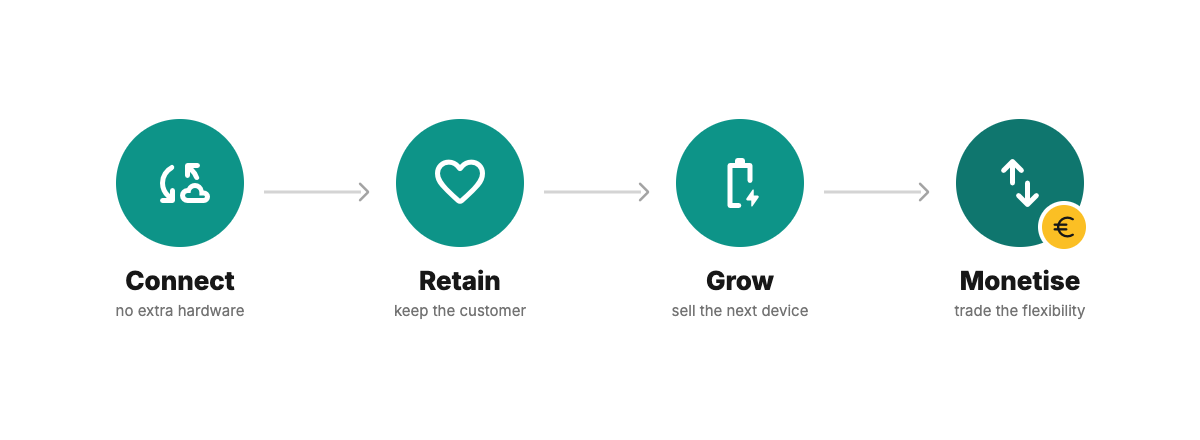
The utilities getting ahead treat the installed base as a pipeline with four steps: connect the assets, retain the customer, grow the relationship, and monetise the flexibility. Each step below is backed by an energy retailer that has already done it, with its numbers.
Step 1, Connect: you can't manage what you can't reach
Every later step depends on reading and controlling the inverter, battery, EV or heat pump in the home. Connectivity is the bottleneck, and the fastest route to it runs through software instead of boxes on the wall.
Eneco (Netherlands). Eneco wanted a residential virtual power plant, which meant reaching EVs, home batteries, heat pumps and solar inverters from dozens of manufacturers. Even at its size, it chose not to build those integrations itself. It plugged in Enode and got access to more than 1,000 device models across 100+ brands without negotiating with a single manufacturer. Its Chief Digital Officer, Vincent Tuk, says the partnership was "instrumental in helping Eneco accelerate our VPP strategy" (Enode).
Integrating manufacturers one by one is ongoing work because manufacturers change their APIs and every new model needs updating and testing. What sets a retailer apart isn’t managing the connections, it’s what it does with the data, bringing that data in is a transaction they can comfortably avoid and Eneco seems to agree. With the data layer solved, its own team could focus on energy logic, grid services and customer experience.
1KOMMA5° (Germany). Its Heartbeat AI platform used to manage only the systems 1KOMMA5° had installed itself. In 2024 it opened the platform to compatible heat pumps, storage systems and wallboxes bought from any brand and installer, and connected systems rose to 40,000, making it Europe's largest residential virtual power plant.
That growth came from equipment 1KOMMA5° never sold. The same logic applies to any retailer. Your real solar base is every customer you sell energy to that also has panels on the roof, regardless of who installed them. If you only count the installations you sold, you are looking at a fraction of it.
The question for your team: what share of your solar customers' inverters can you read today? That number caps everything that follows.
Step 2, Retain: engaged customers stay, and you can see churn coming
Customers who regularly look at their energy data through the retailer's digital channels leave less often.
Bidgely: three European retailers, 1.15 million customers. Bidgely analysed data from 2020 to 2025 across three European retailers, covering around 1.15 million customers who use the energy app or portal Bidgely powers for each retailer. Across all three, sustained engagement correlated with lower annual churn. The headline results:
- One retailer cut annual churn by 44% over two years. Its customers who stayed used the app or portal 46% more often than those who left.
- The second retailer analysed cut churn by 20% while almost doubling the number of customers using its energy app. The effect held up as the app reached more of the customer base.
- At the third, customers who later left had turned down personalised energy tips 52% more often than those who stayed.
Clevergy (Spain): the same analysis, solar households only. Bidgely's study covers all residential customers, so we ran a similar one with our own data and focused on solar households. From a sample of 15,000 customers of five Spanish retailers, we compared solar customers with and without an app that monitors their installation and links it to their consumption and bills. With the app, first-year churn was 54% lower, with 16.3% of them leaving against 35.6% of those without it.
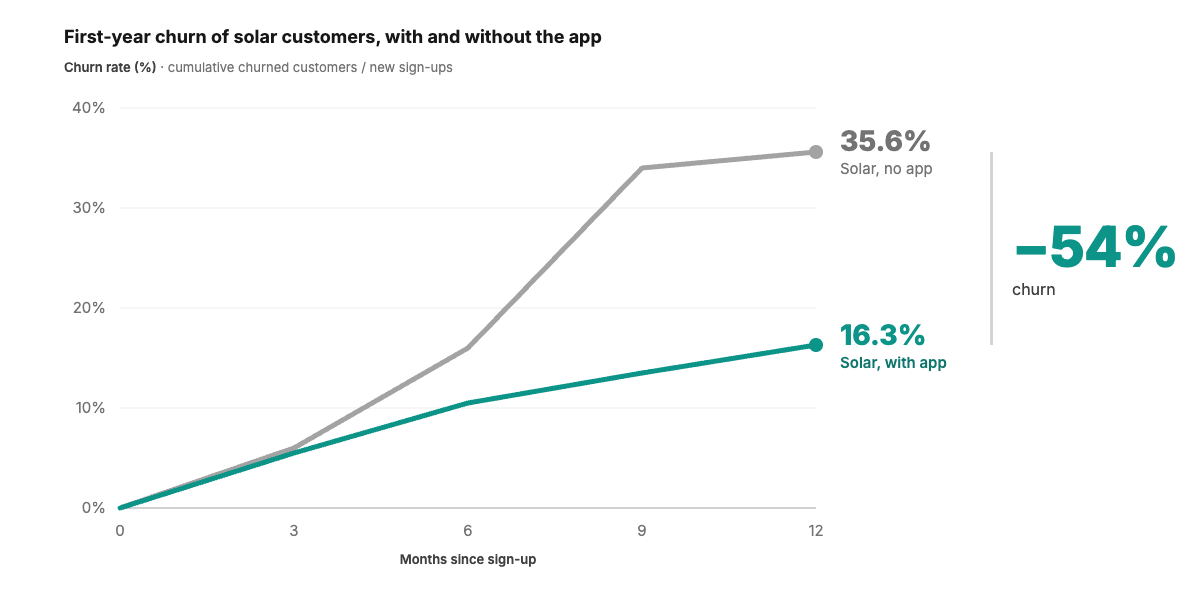
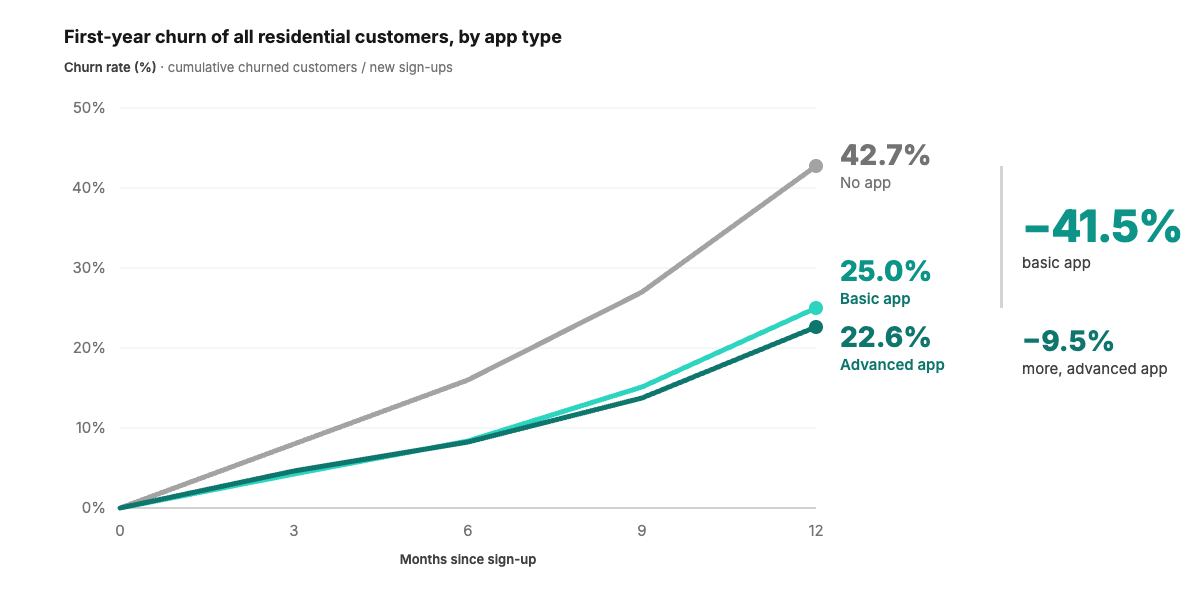
Looking after the solar customer with insights on their installation keeps them with your company for longer. And that base of customers who stay is where the next battery sale, and later the flexibility, will come from.
The question for your team: what do your solar customers get from you today that a customer without panels doesn't?
Step 3, Grow: your next battery sale is already on a roof you serve
The cheapest customer to sell a battery to is one who already has panels. Their data tells you who exports the most, and their trust in you is already earned.
Rocky Mountain Power and ES Solar (Utah, US). The utility, Rocky Mountain Power, pays an upfront incentive to customers who add a battery to panels they already have, on condition that the battery joins its virtual power plant. ES Solar, an installer, saw a sales opportunity in that incentive. It contacted homes that already had panels and ended up selling 18 MWh of batteries, more than 75% of its 2024 sales. It now aims at about 32,000 homes in five years, roughly 40% of the state's ~80,000 solar homes without a battery.
ES Solar needed a utility programme and a marketing push to find those homes. A retailer already has them in its base. With the right technology it can analyse the customers' surplus and consumption patterns, and offer them a battery directly at the right time. That battery can then feed the retailer's own flexibility programme, with an incentive like Rocky Mountain Power’s or without one.
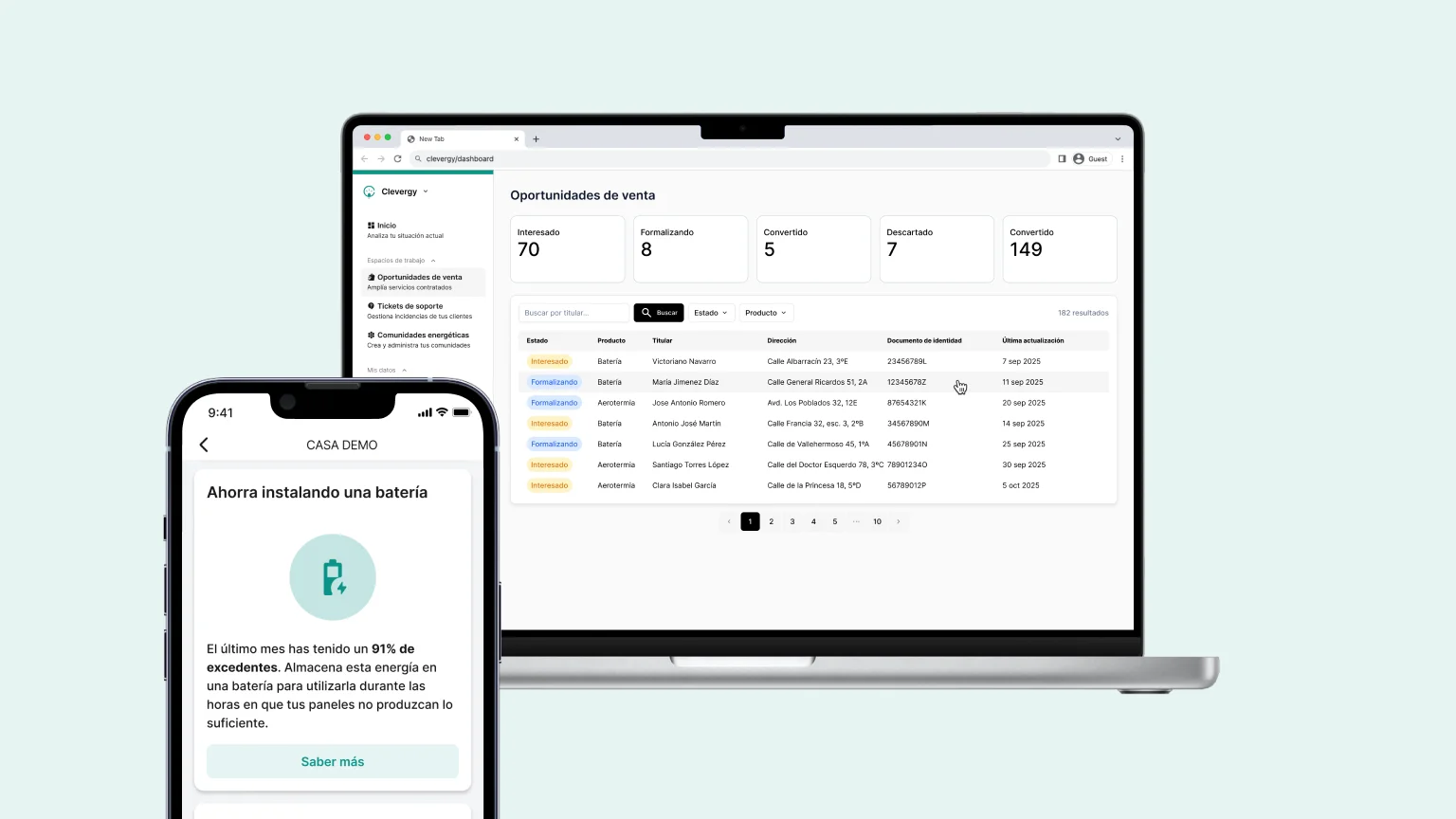
Comunidad Solar (Spain), with Clevergy: the same logic, triggered by data. Comunidad Solar, a self-consumption company, uses Clevergy's platform to connect and access each household and its devices. In June 2025 it used its customers' consumption and generation data, and Clevergy’s sales opportunities feature to pick the households most likely to want a battery and offer it through the app, and in less than two months it generated more than 250 battery leads from existing customers. The trigger sits in having this prosumer data and knowing how to act on it.
The question for your team: can you list your 500 solar customers most likely to buy a battery today?
Step 4, Monetise: put the assets’ flexible capacity to work
A connected battery can earn money for the customer and the retailer at the same time. Two European cases show how, one with a rollout any retailer could copy and one without dynamic tariffs.
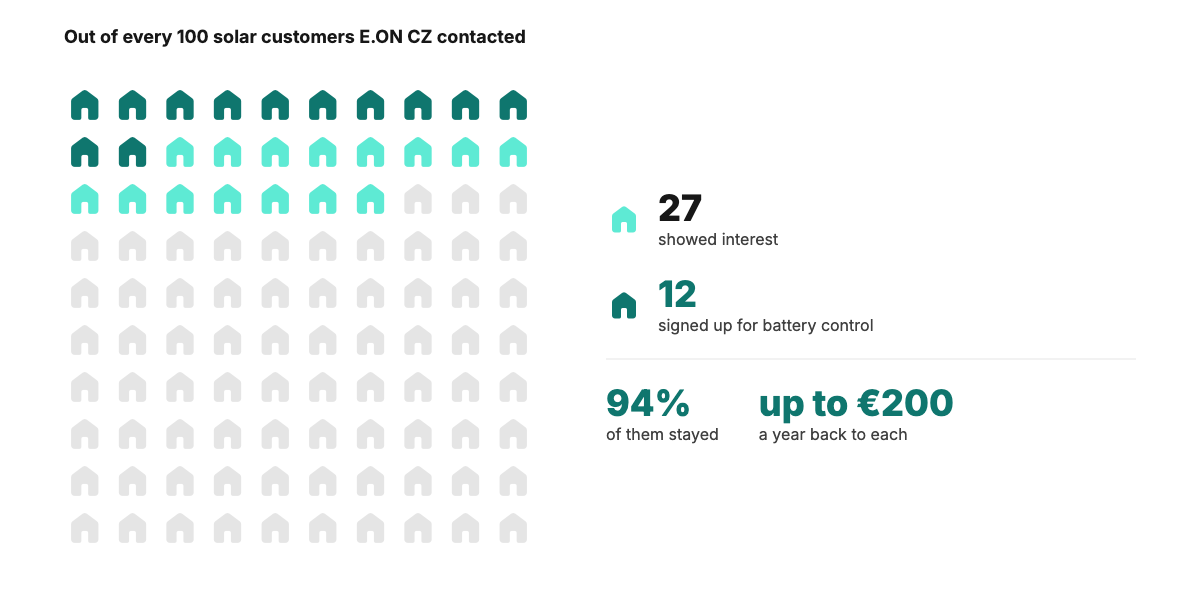
E.ON Czech Republic: the replicable pilot. E.ON CZ couldn't predict its solar customers. It only saw aggregated data, so it never knew how much those homes would consume or export, and every time its forecast missed, it paid imbalance costs. To fix it, E.ON connected their inverters and batteries to a virtual power plant. With real-time data it forecast those homes better, and when its portfolio was short or long, it charged or discharged the batteries to close the gap. It filled the pilot by contacting existing solar customers with personalised emails and calls. The funnel, from the Delta Green × E.ON CZ case study:
- 27% of contacted customers showed interest; 12% enrolled from cold outreach.
- Only 6% of participants left the pilot once it started, with a customer satisfaction score of 9.43 out of 10.
- The flexibility was worth enough for E.ON to pass up to €200 a year back to each household, through lower bills and a fixed monthly reward for letting it manage the battery. E.ON chose a fixed reward over a variable one to keep the offer simple to explain and to scale.
The rollout followed small, low-risk steps: a one-month test with 10 employees, then 65 customers, then a commercial product, E.ON Balance. It now onboards about 500 devices a month, targeting more than 3,000 solar customers (case study, 2025).
Eneco (Netherlands): flexibility without a dynamic tariff. Many retailers assume flexibility needs dynamic pricing first. In a year-long pilot whose results it published in April 2026, Eneco tested the opposite with around 100 customers on fixed or variable contracts, with solar panels and a home battery. Eneco steered the batteries to maximise each household's self-consumption and only stepped in to use them for the grid at specific moments where it needed it.
On average, Eneco used a battery for smart management only 30 minutes a day. The other 23 and a half hours it worked for the household. That takes care of the customer's most obvious fear, that the retailer will drain their battery right when they need it. Eneco now plans to offer battery control to more customers during 2026. It is not new territory for Eneco either. Years earlier, its CrowdNett programme already paid battery owners €450 a year, guaranteed for five years, for 30% of their battery capacity.
The question for your team: How much flexibility is sitting in your solar customers’ batteries today, and who is capturing its value?
What this means for your solar team
The four steps work as a sequence. You cannot sell a battery to a customer you have lost, and you cannot trade flexibility from a device you cannot reach.
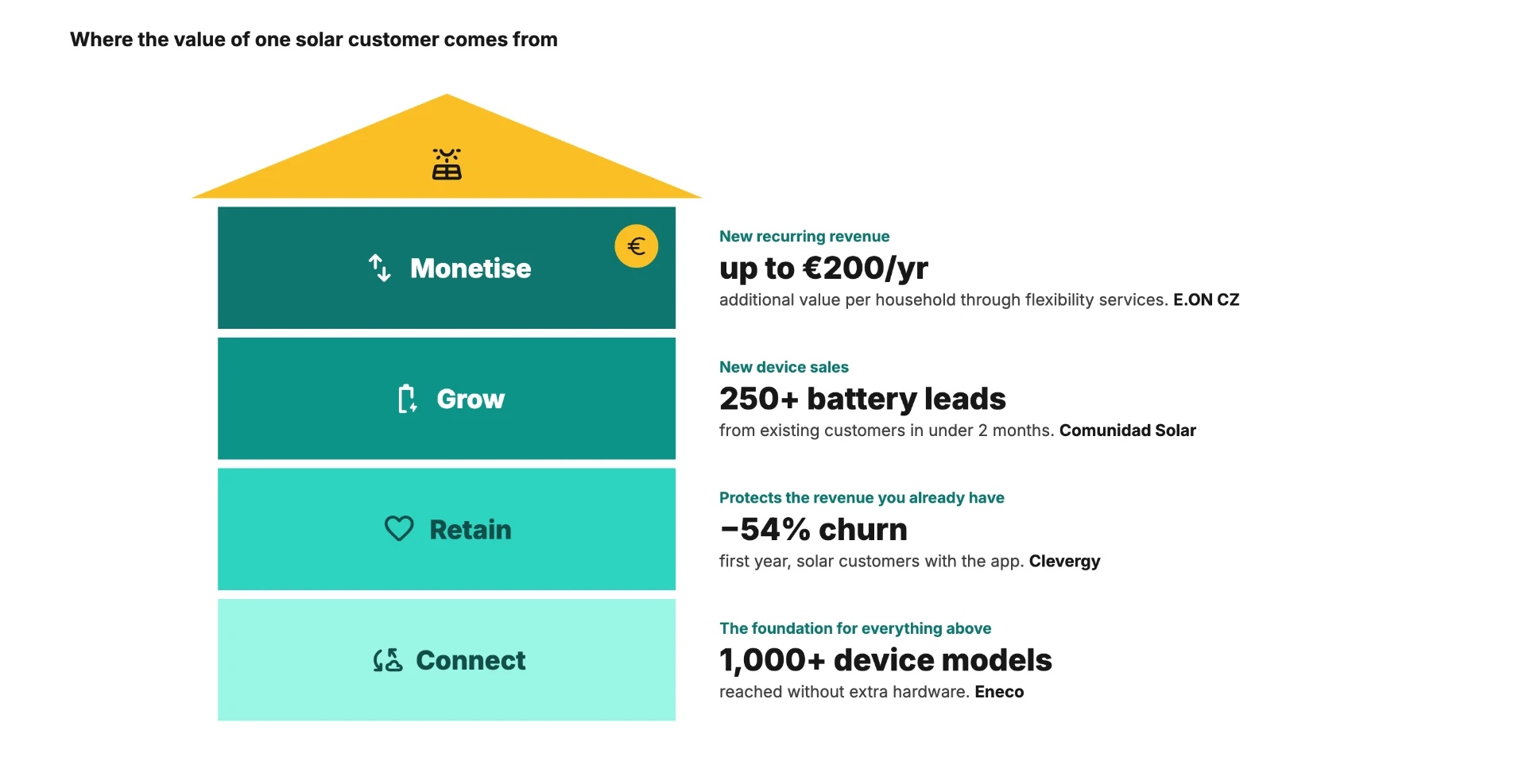
- Connect every inverter, battery, EV and heat pump in your customer base, regardless of brand.
- Retain by giving solar customers a reason to open your digital channels.
- Grow by turning customer production and consumption data into energy assets cross-sell opportunities.
- Monetise by enrolling the connected base in flexibility, starting with a small pilot.
You don’t need to build any of this to get started. Pick a tech partner that already covers the four steps, without pulling your team off its current roadmap.
Clevergy helps utilities across Europe connect, retain, grow and monetise their solar customers through its energy management platform and the flexibility layer on top. If this area interests you, let's talk.
Sources
- 1KOMMA5° - Preliminary business figures for 2024 (February 2025)
- Bidgely - Customer churn in European energy retail: what the data shows
- Clevergy - Generate real sales opportunities with your self-consumption customers (July 2025)
- Clevergy - Ranking de Apps de Energía 2026 (May 2026)
- Delta Green × E.ON CZ - case study "E.ON CZ boosts customer value by 200 EUR/year with flexibility" (2025, PDF)
- Electrek - Energy company subsidizes hundreds of Tesla Powerwalls to create 'virtual power plant'
- Eneco - Smart home battery control becomes possible for fixed and variable energy contracts (April 2026)
- Enode - How Eneco is realizing their vision for a residential VPP offering
- Renewable Energy World - A new market emerges: retrofitting batteries to existing residential solar
- Solar Magazine - Eneco: slim aansturen thuisbatterij ook succesvol bij vast en variabel contract (April 2026)
- Solar Power World - Rocky Mountain Power is paying solar customers more incentives if they add storage later (September 2024)
- tech.eu - Delta Green raises €2M to turn European homes into virtual power batteries (October 2025)
- Utility Dive - ES Solar, sonnen deploy 18 MWh of home battery retrofits through Rocky Mountain Power