The cost of doing nothing
January 2024, and in the mind of the solar PV sector lingers the question of whether 2023 was merely a transition year with a significant drop in residential self-consumption or, on the contrary, a year that demonstrates a shift in cycle towards a consolidation of the sector.
Looking back, we can still picture a distant 2022 with a record 2,649 MW in new installations (39% in homes)[1], driven in large part by the excitement (sometimes fictitious) around state subsidies, but primarily by households' perception of high electricity prices. Behind us, a recently dodged 2023 whose sector business figures fall considerably short of those of the previous year, despite having reached 300,000 homes and surpassed 54,000 business installations generating energy on their own rooftops (some 5.5 TWh, exceeding 2% of the national total)[2].
With these figures, the power system closes out a 2023 in which solar PV represented 14.5% of national generation (37.3 TWh according to REE's provisional data[3]). Of these, 7.26 TWh correspond to self-consumption (3% of national electricity demand)[1], with 1,943 MW[1] installed in 2023 for self-consumption. It is worth noting that industrial installations account for 72.9% of the installed capacity, having suffered a much smaller reduction in 2023 than residential (which, broadly speaking, was halved):

The horizon of self-consumption
On the horizon, the roadmaps promise the emergence of a power system with explicitly flexible demand that will enable the complete decarbonisation of the economy, thanks to new energy players in the residential sector, such as electric mobility, heat pumps and energy storage, or industrial electrification and renewable hydrogen themselves.
Along the way, new challenges such as the CAEs (Energy Savings Certificates) which, while putting the electricity retailing sector in check, enable the creation of new, innovative strategies that manage to make the most of this compliance obligation.
Shifting administrative policies
At play, all kinds of shifting administrative policies that sometimes blow in our favour, such as innovation subsidies aimed at developing new business models for the energy transition, and just as often blow against us, such as the new PVPC tariff that disincentivises consumption optimisation, fostering a stable price certainty for those individuals unconcerned about their energy management while capping the implicit flexibility of those agents who are willing to disrupt their consumption habits.
Common to all of this, the bureaucratic obstacles that can be experienced in the granting of new permits and subsidies for these electricity generation and consumption technologies, as well as the lack of clear regulation that facilitates the deployment of new self-consumption models, such as energy communities. Suffering this uncertainty, it seems fair to doubt Spain's ability to implement an independent aggregator figure that favours the interest of businesses (and prosumers) in becoming part of this technological competition.
Red ocean and blue ocean
With these premises, knowing the new games we want to take part in in the future, it seems that if we look through a spyglass towards the horizon we can make out a blue ocean, still to be navigated, in which new markets that are still empty promise to be affordably conquerable, whose growth is set to be rapid, and in which competition among the few companies that reach it will even be advantageous. However, when we lower the spyglass and look at the waters we are crossing, we see that we are surrounded by a red ocean in which competition to cut costs is voracious [4].
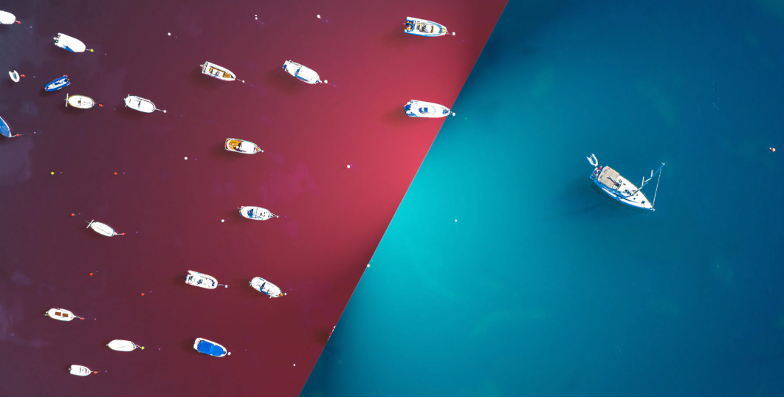
Had they known a couple of years ago, be assured that solar PV installer companies would have opted for other business models that would secure recurring revenue and allow the constant delivery of added value from the products they sold. Unfortunately, the high demand for solar PV self-consumption installations led us to believe that the one-off payment business model would be enough to cover the operating costs tied to the human teams responsible for carrying out the maintenance of these installations.
To innovate or not to innovate
Coupled with this commitment to fixed operational expenditure decoupled from the variable income of new one-off payment sales, there is the difficulty companies in the sector have in differentiating themselves from their competitors, especially due to the lack of innovation; their disconnection from customers, despite having sold them a product that sits on top of their homes just a couple of years ago, which blocks them from other opportunities, such as cross-selling capability (aerothermal energy, charging points, batteries and even home automation) or the monetisation of other energy services, such as *switching*, the fairly remunerated maintenance of the installation or even the acquisition of new customers, derived from a satisfying message passed on by word of mouth (or mobile to mobile, these days). In these companies' defence, it must be acknowledged that they were not bad decisions, they were simply made with the data available at that time (higher margins, higher installation volumes, etc.); in any case, they were short-termist strategies.
Fortunately, at least for those of us who are techno-optimists, these at-risk companies are still in time to innovate, as they have the opportunity to adapt to market trends, creating contingency plans that, even if they seem risky because they involve an investment in technology, are the only solution that in the medium and long term guarantees taking a step forward that places them aligned with their customers' needs.
Together on this journey
At Clevergy, a technology *startup* in the energy sector focused on the development of digital products, this need to do something new and bet on new user-focused solutions reminds us of those undertaken by Netflix two decades ago, when Reed Hastings' company was already aware of the revolution looming in its sector and decided to invest between 1% and 2% of its revenue in developing a new business model based on films over the internet[5]. The company, despite being wrapped in a red ocean of competitiveness to cut the shipping costs of its DVDs to win the battle against Blockbuster, understood that its customers' need was not to rent films, nor to download them from the internet, but to comfortably enjoy their leisure time at home.
As in this case, there are transitions in which innovating can not only mean leading the market, but also where the cost of doing nothing means the non-survival of the company. It is up to each company to decide whether one more annual cycle is needed to confirm the turbulent forecasts about current business models in the self-consumption sector or, on the contrary, whether 2023 has confirmed a change in trend that ought to awaken companies' eagerness to innovate in their value proposition towards consumers.
References
[2] 1st Annual Report on Solar PV Self-consumption - APPA Autoconsumo
[3] Generation structure 2023 - REData
[4] Red ocean and blue ocean: how do these business strategies differ? - BBVA
[5] Information taken from Melissa Perri's book "Escaping the build trap"