BeClever, June 2025
Welcome to the June edition of BeClever, Clevergy's energy newsletter! As every month, we bring you the latest news from the energy sector. The Royal Decree-Law and the consequences of the blackout are the highlights of this month's newsletter.
Royal Decree-Law 7/2025 on urgent measures to reinforce the electricity system
Following the blackout that took place on 28 April in Spain, the Government approved a Royal Decree-Law on 24 June with a whole series of measures aimed at resolving the shortcomings detected in the system as soon as possible and "contributing to the reinforcement of the Spanish electricity system, as well as achieving savings in energy costs for consumers as a whole, while also bringing certainty to all agents".
Royal Decree-Law 7/2025 proposes urgent measures to reinforce the Spanish electricity system following the crisis of 28 April, structured around eight major areas:
- Reinforcement of system supervision and verification, and data transparency
- Centralisation and improved access to users' consumption data
- Strengthening of voltage control and resilience of the transmission network
- Promotion and simplification of energy storage, especially hybridised with renewables
- Greater flexibility and promotion of independent aggregation and self-consumption
- Review and streamlining of grid and infrastructure planning and processing
- Reactivation of incentives for industrial electrification, mobility and heating/cooling
- Acceleration of the integration and repowering of renewables
The decree-law reinforces the supervisory role of the Comisión Nacional de los Mercados y la Competencia (CNMC), and the electricity system management role of Red Eléctrica de España (REE).
Among all the specific measures, it is worth highlighting the recognition that "*consumers' energy metering data is one of the key elements of the energy transition*" and the assignment to Red Eléctrica of the task of creating a system that serves as a single access point for the visibility and availability of energy data. It is not yet clear whether a new system will be created and when it will be implemented: currently this data is available either on Datadis or from distributors.
Another positive point, widely applauded in the sector by associations such as ENTRA, is the reinforcement of the role of the independent aggregator as a key player for flexibility. The aim is for the independent aggregator to have an active role in the electricity markets to develop demand response and empower consumers. Self-consumption managers also appear, a new regulated role made up of individuals or legal entities that represent the interests of consumers associated with a self-consumption installation, authorised by them, carrying out on their behalf the necessary procedures for its proper operation.
Energy communities will also benefit from the increase in the maximum distance between generation and consumption to 5 km: "*we are incorporating a fundamental measure to also favour the competitiveness of our industry, but also of consumers, a measure we call five-by-five, which extends the self-consumption radius to 5 kilometres for projects of up to five megawatts*", said Sara Aagesen, Minister for the Ecological Transition, at the presentation of the decree-law.
There are also specific measures to speed up procedures and promote storage installations, measures to encourage the installation of air-source and geothermal heat pumps, promotion and repowering of renewables, and many others relating to the control and stability of generation.
The Spanish electricity market after the blackout
As we have seen, the decree-law presented this week aims to change many things to improve the system, but there are other issues still to be resolved. To prevent further blackouts, the energy mix has changed, with an increase in technologies that generate stability, such as gas, nuclear power and hydropower, with a much higher margin than usual and wasting renewable energy. As a result, the cost of electricity has increased due to technical restrictions and balancing services, affecting independent energy suppliers above all. According to ACIE (Asociación de Comercializadores Independientes de Energía), the cost of technical restrictions rose from 11 euros per megawatt in April to 24 euros in May. May's balancing services were the most expensive on record, and the difference is notable, as can be seen in this chart published by Energías Renovables.
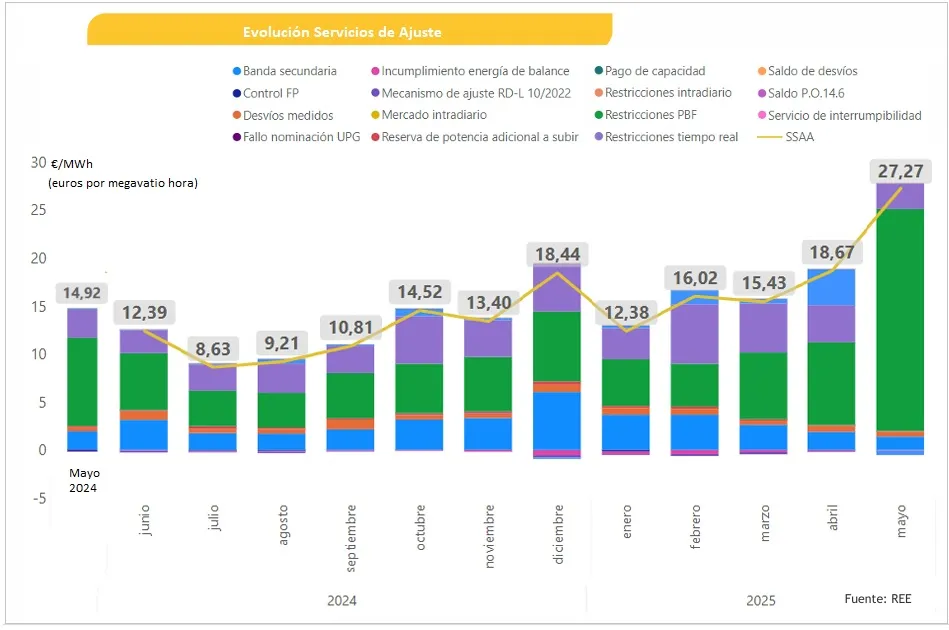
As a result, the bill of the 8.3 million households on the regulated electricity tariff (PVPC) would have risen by 15% in May's settlement. In the free market, some suppliers such as Gana Energía added an extra 6% charge to their customers' bills to cover the increase in system costs.
Finally, this week the CNMC (Comisión Nacional de los Mercados y la Competencia) decided to ban electricity suppliers from introducing a charge to offset the costs arising from the "anti-blackout measures".
This ban has been strongly opposed by independent suppliers, whose margins are lower and who therefore face a difficult situation. ACENEL (La Asociación de Comercializadores de Energía Eléctrica) has expressed its deep concern that suppliers or consumers should be the ones to bear the economic consequences of the blackout, and propose that the extra cost be added to the bill via access tariffs, as is the case with tolls, charges or capacity payments.
We are talking about around 2,000 million euros, and although the CNMC also approved the new rules for voltage control and a new protocol for possible blackouts on 12 June, everything suggests that the new protocol will not be ready until the first quarter of 2026, and until then balancing services will remain high. Meanwhile, a lot of renewable energy continues to be wasted. Last May, one in every five megawatts generated by solar photovoltaic energy was wasted.
Energéticamente, we talk about energy
Last month we launched Energéticamente, a podcast in which we talk about energy, and we have already released three episodes:
- Jorge González (Contigo Energía)
- Jaime Arbona and Gonzalo Lahera (Selectra)
- Jose Antonio González (Repsol)
You can watch or listen to Energéticamente on YouTube, Spotify, Apple Podcast or iVoox