Users who monitor their energy consumption are the ones who save the most
According to a study we carried out using electricity consumption data from 47,686 Spanish households, the users who most regularly monitor their energy spending are the ones who most contain their consumption, achieving savings of between 6% and 19%.
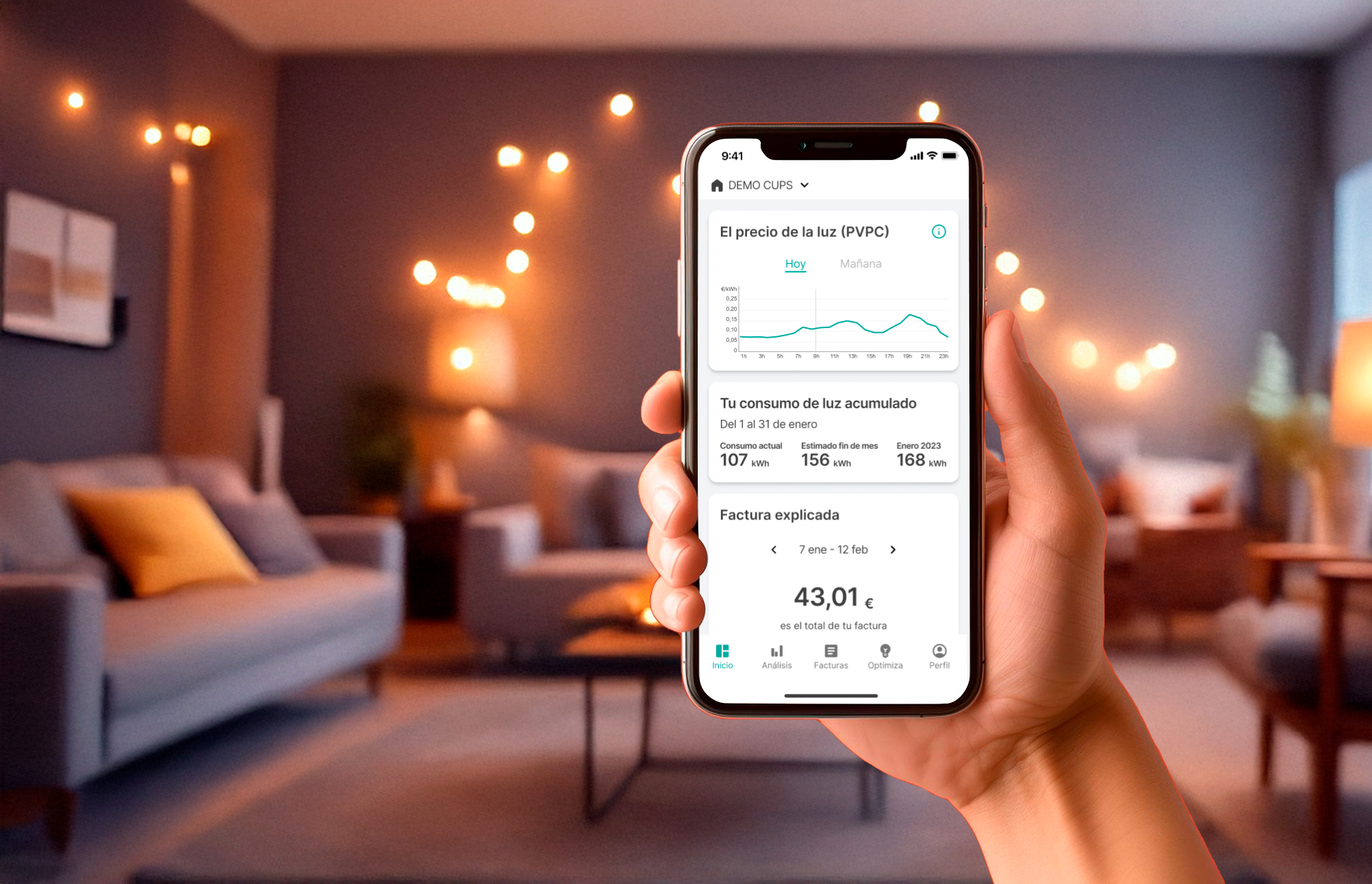
Since the arrival of smartphones, being able to keep track of any type of expense, such as banking or telephone costs, with an app has become very common. However, monitoring energy consumption is not usually as commonplace, and many utilities either do not have an app, or the one they offer barely allows much more than downloading invoices and viewing contracts.
Knowing and understanding your consumption are key to achieving energy savings. Being able to compare your consumption with other similar households, having high-consumption alerts, anticipating your projected consumption for the end of the month, or knowing which appliances use the most, are all features that allow consumers to control their energy consumption.
In the study we analysed the behaviours of the users who use our applications, dividing them into three broad groups according to their annual energy consumption: households with high consumption (above 5,256 kWh), households with medium consumption (above 2,628 kWh and below 5,255 kWh), and households with low annual consumption (below 2,628 kWh).
We collected the data of 47,686 households, from which those with photovoltaic installations were excluded, as they have very different consumption behaviours. The data was collected for the first half of 2024 and compared with that of the same period in 2023. The conclusion of this study is clear: the users who made the most use of Clevergy's applications are the ones who most adjusted their consumption and therefore their spending.
High-consumption households (above 5,256 kWh per year)
Despite the fact that the averages for residential supply points as a whole increased their consumption in the first half of 2024 compared with 2023, within the group of users with high consumption (monthly consumption above 438 kWh), those who made heavy use of the apps consumed on average 19.87% less than those who used them less.
Although their consumption remains high, owing to having electric climate-control equipment, the apps' tools appear to have made it easier to understand the spending these devices represent and, consequently, have fostered greater awareness among these users of energy efficiency, and therefore savings, in their homes.
Medium-consumption households (between 2,628 kWh and 5,256 kWh per year)
As with high-consumption households, the differences in consumption are substantial but less marked. In these households, the users who made heavy use of the app consumed on average 6.8% less than the users who consulted these applications least.
The difference is smaller because these homes with intermediate consumption show greater disparity in the climate-control equipment in their dwellings: not all of them have electric climate-control equipment, such as heat pumps; rather, it is a mix of homes with gas equipment, heat pumps with lower power than in the previous case, electric radiators, central heating, and so on. In most of these cases, the potential for electricity savings is lower, since the heat generated in the winter months comes from combustion equipment or from equipment not directly controlled by the occupants of those supply points.
Low-consumption households (below 2,628 kWh per year)
In this last case, the users who made heavy use of Clevergy's apps consumed 9.07% less than the users who did not use them. This indicates that, although this group of users presents a more limited margin for optimising electricity consumption, frequent use of the app remains effective in encouraging more responsible energy consumption habits.
The homes in this group have lower electricity consumption mainly because of the nature of their consumption equipment. In most cases, these households have centralised climate-control systems (central heating in their buildings), which reduces reliance on intensive electric equipment such as heat pumps. In addition, their electricity consumption is less seasonal, as they do not depend on electric climate-control systems to get through the coldest months of the year. Likewise, another distinctive feature of these homes is the limited use of electrical equipment: in general, the households in this cluster use basic appliances, such as a single fridge and freezer, do not usually have tumble dryers, and tend to use intensive appliances such as the oven less frequently.
The importance of contracted power
In addition to consumption, it is important to keep contracted power under control, since it represents the fixed term of the bill. More than half of Spanish households have contracted more power than they need. In a study published in 2023 by the CNMC (Comisión Nacional de los Mercados y la Competencia) 63% of Spanish households had on average contracted 1.1kW too much during peak hours, and 67% exceeded the power needed during off-peak hours by 1.6kW. This figure alone represents a total extra cost of more than €600 million per year. The data from the Clevergy report confirm this figure, with 3.5 kW being the average contracted power in Spanish households. Clevergy's apps also help consumers to adjust their contracted power to avoid these unnecessary costs.