The electric domino: anatomy of a national collapse in the age of renewables

On 28 April 2025, at 12:33 midday, Spain lost its electricity.
Trains came to a halt. Automatic doors would not open. In the cities, traffic lights stopped working and driving became a game of guesswork. Card payments vanished. Telecommunications, cut off. Within seconds, millions of people were disconnected from the energy that powers the country, without warning.
But this article is not about that.
It is not a chronicle of what happened. The news outlets are there for that. This text tries to answer a far more important question:
How is it possible for disconnecting one or two power plants to end up switching off an entire country in five seconds?
In other words, how can a local failure have national consequences?
Answering that is not just about understanding what failed. It is about knowing what we can improve. Because what happened on Monday was not just a one-off failure: it was a demonstration of how large and complex the power grid is, and of how fragile it can be when something breaks in the wrong place and at the wrong moment.
A grid that never sleeps
The power grid is not infrastructure. It is a machine.
A machine that has been running non-stop for more than a century. That connects thousands of generation points with millions of consumption points. That adjusts its own innards every second so that everything works. And that, unlike a motorway, tolerates no traffic jams.
Before we analyse the blackout, it is worth pausing for a moment. To understand what happened on 28 April, reading headlines or figures is not enough. You have to properly understand the sector's two golden rules. That is what makes it possible to grasp why a power grid can go into crisis in just seconds. This brief recap is not for experts: it is for anyone who wants to truly understand how the system that gives us electricity every day works.
Electricity cannot be stored (at large scale).
This refers to power. Power is the real capacity to do useful work. Switching on a light bulb, moving a train or opening the lift doors.
What is produced is consumed.
What is consumed is produced.
Every second.
That is the first golden rule.
\*We have “overlooked” storage (batteries and pumped-storage plants) because they are, for now, of little relevance.
The system frequency is 50Hz
Frequency is the rhythm at which the whole system turns. In Europe, everything must turn at exactly 50 Hz. No more, no less.
If more is consumed than expected, the frequency drops, the generators turn more slowly and can end up decoupling entirely from the grid, causing a disconnection.
If more is produced than needed, the frequency rises, the machines turn faster and can break.
That is why the frequency must always be 50 Hz.
The first domino tile
In the blackout of 28 April, what is surprising is not that the system collapsed. What is surprising is the speed at which it did so: 15 gigawatts out of service in less than five seconds. But that did not start with 15 gigawatts (GW).
It started, as always, with one.
The hypothesis being considered at present is that one or two large plants disconnected first. We do not know which ones, but we do know it happened in the south-west of the peninsula.
Think of a combined-cycle plant of around 800MW, or a set of solar farms that lost the ability to inject into the grid. That first loss, of between 1 and 2 GW, was enough to start the imbalance.
And when the frequency falls, so does everything else.
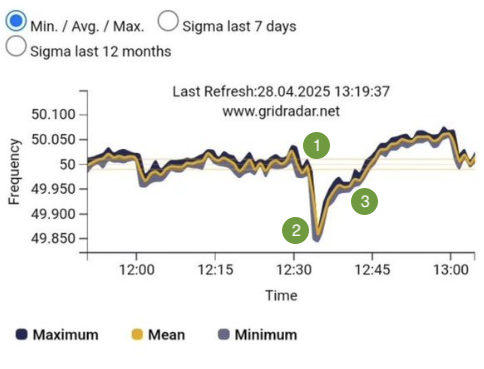
[caption id="attachment\_2163" align="aligncenter" width="484"]!european grid frequency blackout 28 april Source: Gridradar[/caption]
- *The grid frequency in the central European zone begins to fall sharply, trying to cope with the loss of power that has just occurred in Spain.*
- *The European frequency reaches a critical minimum at 49.85 Hz and disconnects the Spanish grid from the rest of Europe to prevent the widespread blackout from spreading.*
- *Spain goes down. Europe begins to bring its frequency back up, though not without being affected as well, if more mildly.*
Because the frequency is the signal shared by all the generators. It is the metronome of the grid. If it drops, it means more is being consumed than is being produced. And if it drops quickly, the automatic protections interpret it as danger: they disconnect plants to protect them, which accelerates the fall.
That was the first tile and from there, everything chained together. When one plant disconnects, the load it was meant to cover is redistributed among the rest. If these are already at their limit or react too late, they fail too. Each new failure pushes the frequency further down, which trips more protections, more disconnections, and so on until the system falls.
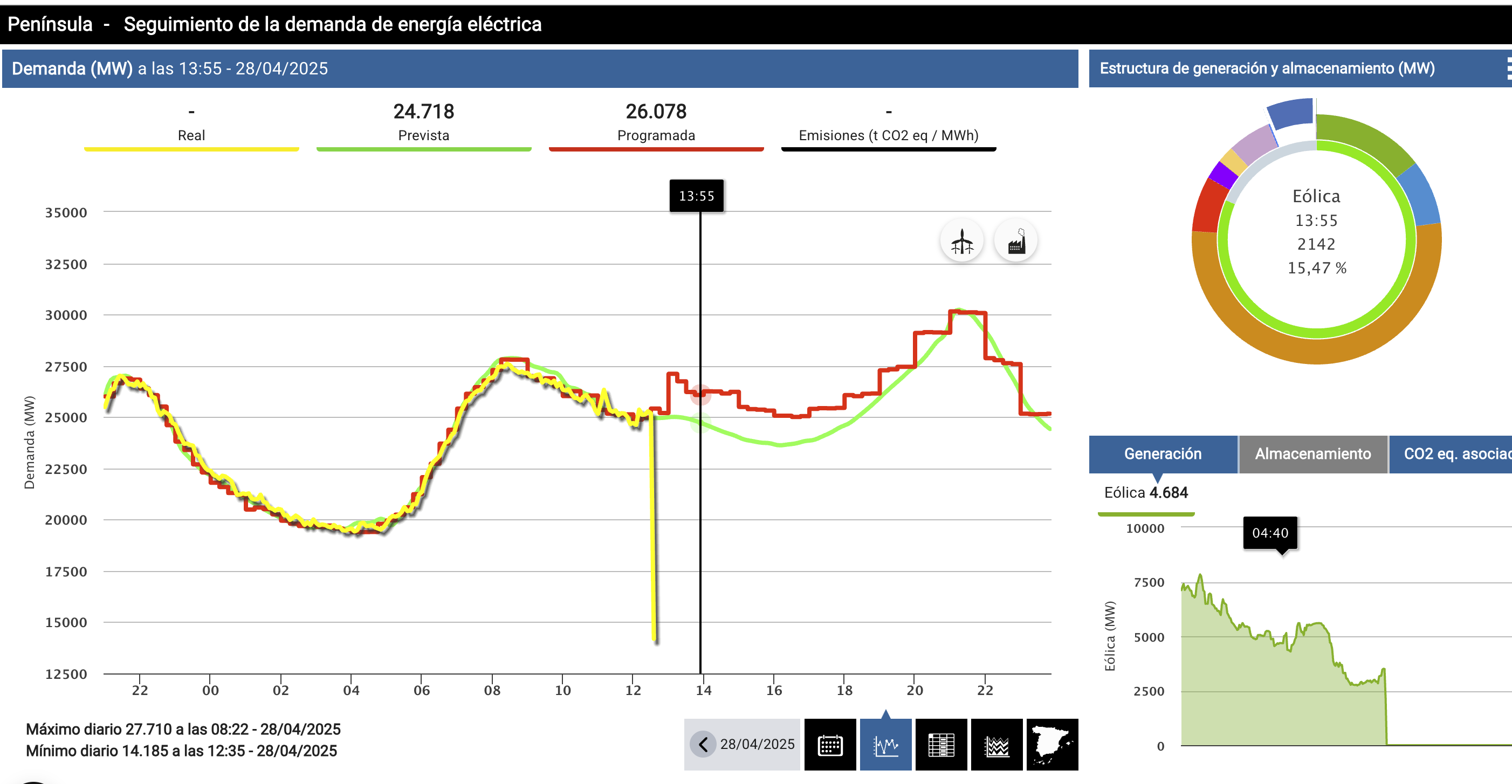
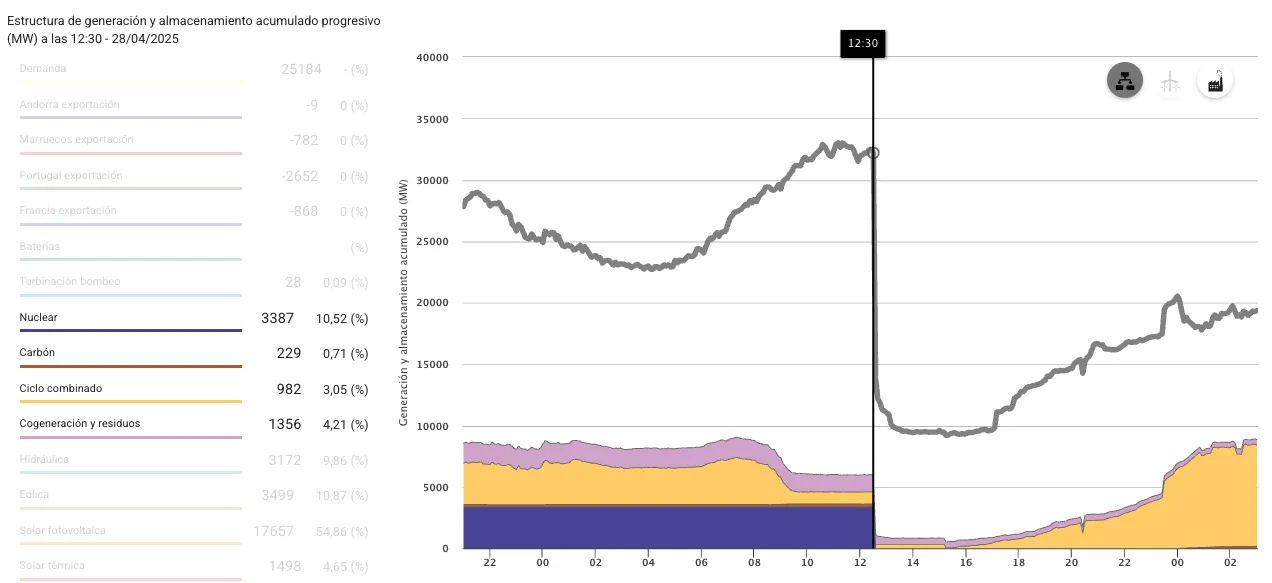
For this reason, the nuclear power plants were the first to disconnect. The protection systems do not wait to understand the context. They act. And each MW that disappears makes the frequency fall even further. That is how you go from 2 to 15 GW out of service in 5 seconds.
[caption id="attachment\_2160" align="aligncenter" width="2560"]!power grid_blackout 28 april Source: Red Eléctrica de España[/caption]
The grid has no time to think. Only to react.
Renewables: part of the solution and of the problem
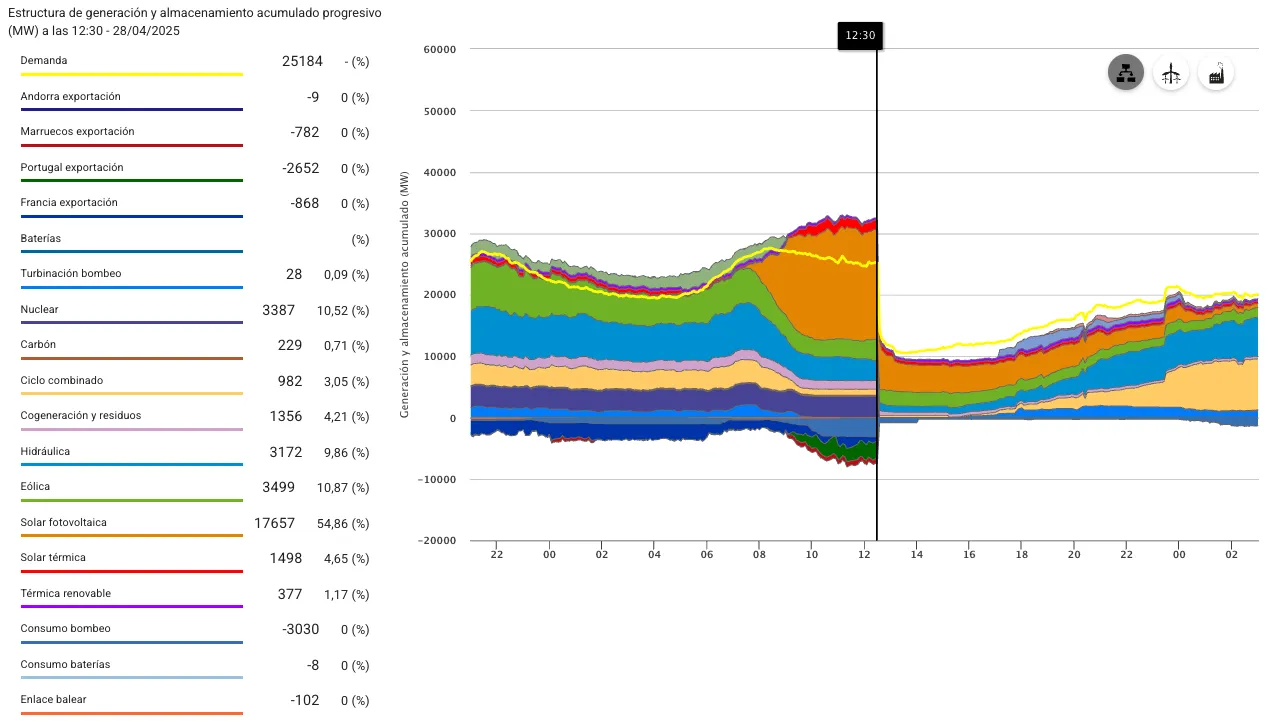
At the moment of the blackout, renewable generation in Spain was at an all-time peak. It was midday, the sky was clear, solar photovoltaics producing more than 17 GW.
[caption id="attachment\_2161" align="aligncenter" width="1273"]!power grid blackout 28 april Source: Red Eléctrica de España[/caption]
Renewables are essential to move towards a cleaner, more sustainable energy model that is less dependent on fossil fuels. Their role is key in the fight against climate change. But that advantage comes with a technical trade-off: the sun and the wind cannot be controlled, and that makes production less predictable and more unstable. Designing a grid that works with these sources requires not only generating them: it requires learning to integrate them without compromising the stability of the system.
In addition, renewables have a problem when it comes to this kind of incident: they are not physically coupled to the grid. They are connected through electronic inverters, and those inverters do not provide inertia.
What is inertia? It is the ability to resist a change. In the electrical system, inertia is provided by the generators that spin: gas turbines, hydro turbines, nuclear cores. When there is a disturbance, their rotating mass helps to stabilise the frequency.
This relationship between power imbalance and frequency drop can be expressed with a simple formula:
-Δf = R × ΔP
- Δf is the variation in frequency
- R a constant that depends inversely on the inertia of the system
- ΔP the variation in the system's net power demand
The goal of the grid is to minimise frequency disturbances in the face of changes in power. To do this, we need R to be as low as possible by adding large generators that spin with the system. Solar does not spin. Wind, only sometimes. When there is little inertia in the system, any disturbance is amplified.
[caption id="attachment\_2162" align="aligncenter" width="1272"]!power grid inertia blackout 28 april Source: Red Eléctrica de España[/caption]
Yesterday the energy sources that provide inertia to the system represented 18.5% of total production. A greater role for these technologies would have reduced the impact of the drop in production on the system frequency.
This does not mean that renewables are to blame, it means that they are part of the solution. These new technologies have been integrated into a system that used to work in a different way. If we want to achieve an effective energy transition, we will have to find a way to provide inertia to the system.
Because the future is renewable, but it cannot be so without stability.
Switching on a country from scratch
After the collapse came the silence. And then, the operation of restoring a system of tens of millions of connections without breaking it again.
This is called "black start": starting from scratch without external help. In Spain, that process began from the edges: France and Morocco injected energy into the border substations. The hydro plants, which can start without a grid, were activated to provide local support. Some gas plants followed, and node by node, the grid was re-energised.
But it had to be done carefully.
If you reconnect too quickly, the system falls again.
If you go too slowly, the country stays switched off.
If this outage dragged on too long, we would have had to reactivate some substations manually, extending this recovery to days.
That is why it “only” took us 17 hours.
And that is why we should applaud it. Because in less than a day, a collapsed system restored service to 99% of the country with no secondary accidents. That is an achievement.
What the blackout tells us about ourselves
This was not a design failure. It was a combination of factors at the worst possible moment. A conjunction of vulnerabilities that were triggered in a chain.
But it was also a demonstration of the scale of our electrical system. Of its complexity. Of its resilience. Of what must be protected and redesigned.
We can no longer think of energy as if it were an invisible service. It is a critical system, as essential as water or air. And also as delicate.
This blackout is a red line. One that marks the limit of a system that is changing fast, but not always by the rules of the past.
We need:
- More real interconnections with Europe.
- Better decentralised automatic response.
- Storage and backup capacity without depending on gas.
- Digital infrastructure at the level of the physical system.
And above all, we need electrical literacy. To understand that the energy transition is not just about swapping coal for panels, but about redesigning the invisible architecture that holds everything up.
28 April gave us a warning. It was not the end of the world. It was a stress test. And now we know how far we can hold out.
The next step is to build from there.