From inertia to control: how a grid without rotating mass is stabilised
As lucid as ever, Joaquín Coronado wrote a few days ago about a subject that tends to lend itself to easy headlines: the stability of the Spanish power grid.
And, as he usually does, he did so without falling into oversimplifications or technological nostalgia. His thesis is clear: the problem with today's power system is not a lack of inertia, but a lack of speed and coordination.
In other words, we don't need more mass spinning, but more intelligence reacting.
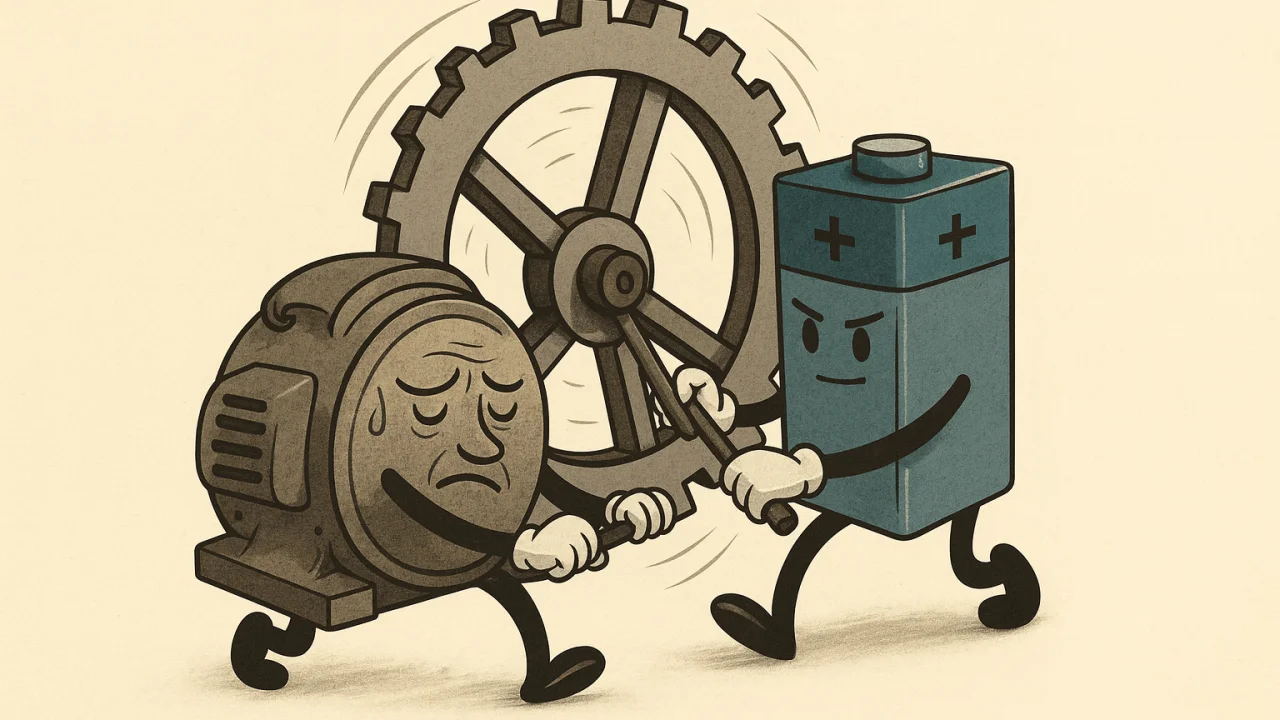
For decades, grid stability relied on the physical inertia of large synchronous generators. When a disturbance occurred, their tonnes of rotating steel would absorb or release energy naturally, damping frequency imbalances. But the energy transition has changed that balance: there are more and more renewables connected through power electronics inverters, which provide no inertia and therefore leave the grid “lighter” and more sensitive.
However, to think that the solution lies in recovering that lost inertia is—as Coronado puts it—looking in the rear-view mirror.
Today we have something that may just be the answer: digital control able to react thousands of times faster than any turbine.
From following the grid to creating it
This is where a technology we've been hearing about since the blackout comes into play: *grid forming*.
I'll admit it put me off for a long time, perhaps because it was always presented with an almost magical air. “new inverters that provide inertia”, “virtual inertia”, “digital synchronous machines”... too many labels for something that seemed intangible.
But behind the jargon lies a simple and powerful idea.
A *grid forming* inverter doesn't merely follow the frequency and voltage of the existing grid, as a conventional inverter does (*grid following*).
Instead, it generates its own voltage and frequency reference, behaving as if it were a virtual synchronous machine. That is, it creates the grid that everything else synchronises to.
To achieve this, the inverter synthetically produces the voltage and current needed to maintain balance, being able to generate or consume active and reactive power by playing with the phase shift of the waves.
In this way, it acts as a controllable “complex power source”, capable of stabilising the grid even in the absence of traditional generators.
It's not magic: it's control, and it has limits
*Grid forming* solves part of the problem, but not all of it.
By replacing physical inertia with virtual inertia, you gain response speed, but new challenges also arise.
- Lack of energy.
If the source behind the inverter (a battery, for example) doesn't have enough energy available, the system can lose its ability to maintain frequency and voltage, causing abrupt loss-of-synchronism disconnections.
In simple terms: without “electrical fuel”, the formed grid collapses.
- Uneven quality.
The stability of a *grid forming* inverter depends largely on the quality of the digital control and its dynamic tuning (the *droop* parameters, damping, etc.).
A poorly calibrated inverter can generate oscillations in voltage or frequency, affecting not only itself but the entire local grid.
- Lack of standards.
Each manufacturer implements its own control model. This means that two *grid forming* inverters from different brands may respond differently to the same disturbance, even ending up “competing” with each other to impose the frequency.
That's why ENTSO-E, IEEE and other bodies are working to define specific grid codes for grid-forming inverters, something that will be essential for their large-scale deployment.
The grid of the future
Coronado's article points in the right direction: the stability of the power system no longer depends on the inertia of steel, but on the intelligence of silicon.
Technologies such as *grid forming*, combined with storage and active demand management, mark a new paradigm: power grids that are stabilised not by their weight, but by their capacity to adapt.
In this paradigm shift, we're no longer talking only about large power plants or operators, but about a grid made up of thousands of active nodes—homes, batteries, electric vehicles—that can dynamically contribute to maintaining the stability of the system.
And this is what's exciting, because it's not magic: it's real-time engineering.